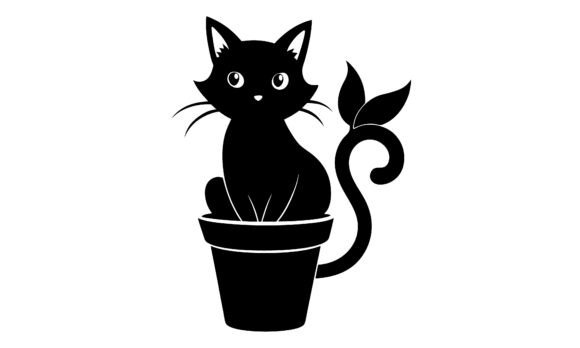
Black Cat in a Plant Pot
As someone who’s stitched hundreds of designs for clients—from boutique baby onesies to Etsy best-selling tote bags—I opened Black Cat in a Plant Pot expecting charm, but what I found was quiet confidence. It’s not flashy or fussy. It’s a compact, centered silhouette: a relaxed cat curled inside a simple ceramic pot, leaves arching just so. No facial features, no intricate fur texture—just clean, intentional outlines and gentle negative space. That restraint is its strength. It reads instantly at 3 inches wide on a sweatshirt chest or 1.75 inches on a tea towel corner. It feels handmade without trying too hard.
What This Design Actually Wants to Be
I tested Black Cat in a Plant Pot as the centerpiece for a custom embroidered linen apron—meant for a local plant shop’s staff gift line. Right away, it made sense: the design’s organic shape mirrors the soft drape of linen, and its modest scale avoids overwhelming the fabric’s natural texture. It didn’t scream “cat lover”—it whispered “thoughtful, grounded, quietly whimsical.” That’s rare. Most cat motifs lean into cartoonish energy or gothic drama. This one sits comfortably between them: friendly enough for a baby embroidery project, refined enough for a wedding gift kitchen towel set.
It works especially well when you’re building cohesive small shop product lines. Imagine it stitched in sage green thread on oat-colored canvas tote bags, then repeated in navy on matching tea towels—and yes, even scaled down (with careful digitizing adjustments) for a tiny patch on a denim cap brim. The shape holds up across those variations because it’s built on balance, not busyness.
Where It Shines—and Where You’ll Need to Pause
Black Cat in a Plant Pot thrives in medium-to-lightweight fabrics with stable weaves: cotton poplin for pillow covers, midweight twill for aprons, brushed poly-cotton for sweatshirts. On those, the satin stitch edges stay crisp, the fill stitch in the pot base reads cleanly, and the leaf curves don’t collapse under tension.
But here’s where real-world testing matters: I tried it on a lightweight rayon-blend baby onesie. Without proper cutaway stabilizer and reduced stitch density, the pot’s curved rim blurred slightly. The cat’s outline held—but only because the original vector has generous line weight. If this were an embroidery file with ultra-thin strokes or tight interior corners, it wouldn’t survive that fabric. As-is? It’s forgiving—but not magic. Always test on scrap first, especially for baby embroidery or holiday embroidery where softness and durability are non-negotiable.
For caps or curved surfaces, keep the hoop size realistic. At under 4 inches wide, Black Cat in a Plant Pot fits most standard hoops—but avoid placing it too close to the seam or bill curve unless your machine handles rehooping smoothly. And on dark fabric? Choose thread colors with contrast in mind. A charcoal gray cat on black fabric disappears. But in cream or warm taupe? It gains warmth and dimension.
Why It Builds Trust—Not Just Cuteness
Customers don’t buy cat motifs. They buy meaning: comfort, calm, personality, care. Black Cat in a Plant Pot delivers that without leaning on cliché. When stitched cleanly on a handmade product—say, a personalized gift for a new plant parent—it signals attention to detail and intentionality. That elevates perceived value, especially for Etsy sellers or craft fair vendors pricing handmade goods above mass-produced alternatives.
I’ve seen how a poorly digitized cat design can undermine brand consistency: jagged edges, inconsistent stitch density, or awkward spacing between pot and cat make a boutique product feel rushed. This one avoids that. Its proportions are harmonious. The negative space around the cat isn’t accidental—it’s breathing room. That translates directly to professionalism in finished product photos, printable mockups, and digital embroidery file previews.
Practical Notes Every Embroidery Designer Should Check
- Test before committing: Run a sample on your target fabric + stabilizer combo. Watch how the leaves hold their shape and whether the pot base fills evenly.
- Review stitch density: High density looks rich on stable fabrics—but can cause puckering on knits or thin cottons. Adjust if needed.
- Confirm hoop compatibility: Measure the design’s widest point. If it’s near your machine’s max hoop width, double-check clearance and thread path.
- Inspect small details: Zoom in on the cat’s tail tip and leaf points. Are they sharp or rounded? That affects how cleanly they stitch out.
- Mock it in context: Drop it into a black-and-white printable mockup first. Does it read clearly at intended size? Then try light/dark fabric overlays.
- Stabilizer strategy: Use tear-away for stable wovens, cutaway for knits or stretchy fabric, and lightweight fusible for delicate items like baby embroidery.
- Licensing check: Since this is a digital embroidery file sold as a Graphics asset, confirm whether commercial use is permitted before selling finished products or bundling it into craft business kits.
A Design That Fits Real Life—Not Just the Screen
There’s a reason I reached for Black Cat in a Plant Pot instead of scrolling past another hundred cat designs: it doesn’t ask for forgiveness. It doesn’t need heavy editing to work on apparel or home goods. It doesn’t fight the fabric—it settles into it. That’s the hallmark of a truly usable embroidery file: it serves the project, not the portfolio.
Whether you’re stitching custom apparel for a local café, prepping holiday embroidery bundles for your Etsy shop, or developing a line of nursery decor, this design earns its place—not because it’s trendy, but because it’s reliable, recognizable, and quietly expressive. It’s the kind of asset that makes customers pause, smile, and say, “I get it.” And in a crowded crafts market, that kind of resonance is worth more than perfect symmetry or extra stitch count.
If you treat Black Cat in a Plant Pot like a collaborator—not just a download—you’ll find it adapts gracefully across tote bag design, sweatshirt embroidery, embroidered patch applications, and even subtle applique design accents. It’s not the loudest option in your library. But it might just be the one you reach for most.