Dancing Cat Silhouette
First Impressions: Playful, Clean, and Surprisingly Versatile
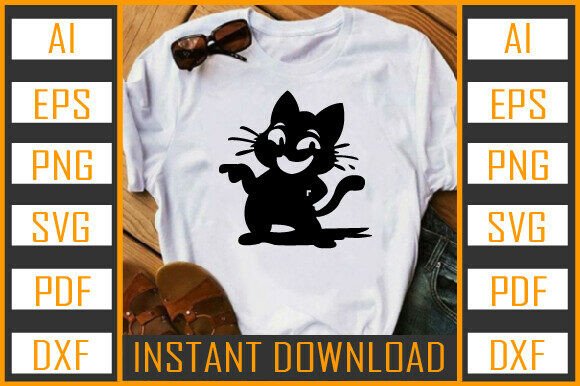
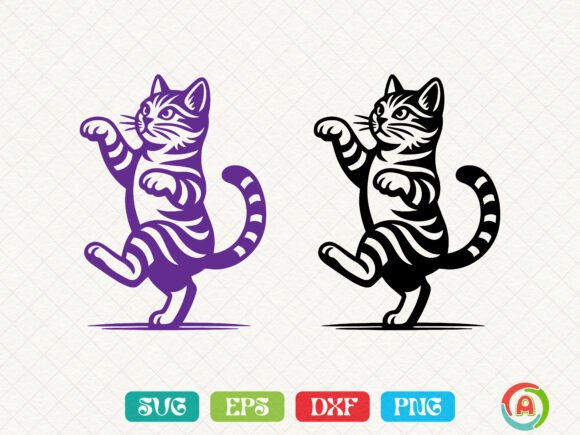
When I opened the Dancing Cat Silhouette files, I didn’t just see a cat—I saw movement. The pose is light and balanced: one paw lifted, tail arcing mid-twirl, ears perked with quiet confidence. It’s not cartoonish or overly stylized—there’s a subtle elegance in the negative space and smooth vector curves. This isn’t a design that shouts; it whispers charm. As a designer who’s stitched hundreds of motifs for baby onesies, boutique aprons, and Etsy patches, I immediately pictured it on a linen tea towel—soft, intentional, quietly joyful. That’s its core mood: approachable whimsy with grown-up restraint.
Where It Shines in Real Embroidery Projects
I tested Dancing Cat Silhouette across three real-use scenarios: a custom embroidered tote bag for a local nursery shop, a set of matching baby onesies for a client’s newborn photoshoot, and a small-batch run of iron-on patches for a craft fair booth. In every case, it held up—not just technically, but emotionally. On the tote, the silhouette read clearly at 4.5" wide, even from across a room. On the onesies, its clean lines translated beautifully into delicate fill stitch without overcrowding the tiny chest area. And as a patch? The SVG and EPS files scaled flawlessly for both 2.5" and 3.75" versions—no pixelation, no jagged edges.
It works especially well for personalized gifts and small shop products where subtlety reads as quality. Think: monogrammed pillow covers with a single dancing cat tucked beside initials, or holiday embroidery on a neutral sweater—no glitter, no bells, just warmth and personality. As an embroidery file, it’s lean enough for quick digitizing (if you’re adapting it yourself), and the vector foundation means you can adjust stroke weight or add a single satin-stitch outline without distortion.
Where to Use It Thoughtfully—Not Just Automatically
That said, Dancing Cat Silhouette isn’t a “drop-and-stitch” solution for every fabric or surface. On stretchy knits like lightweight sweatshirts, I recommend adding a medium-weight cutaway stabilizer—those curved limbs need support to hold shape during stitching. On dark fabrics, test thread colors first: a soft heather gray or warm charcoal reads more sophisticated than stark black, which can flatten the sense of motion. And avoid placing it directly over seams or curved caps unless you’ve pre-tested hoop placement—the tail’s gentle curve tightens slightly when hooped on a dome, so give it breathing room.
It’s also not ideal for ultra-tiny applications (<3"). The inner ear detail and toe lift are expressive, but they shrink into ambiguity below 1.8". For baby embroidery or cap fronts, simplify those elements manually—or better yet, use the PNG version as a guide while redigitizing for clarity. Also, skip dense fill stitches on textured fabrics like terry cloth towels; opt for a clean running stitch outline instead. That’s where the digital embroidery file’s adaptability shines: you control density, not the design.
What It Adds to Your Finished Product—Beyond Aesthetics
Customers don’t just buy a cat—they buy the feeling it carries. When I added Dancing Cat Silhouette to a set of kitchen towels for a handmade shop, buyers commented on how “calm but cheerful” it felt—exactly the tone their brand wanted. That emotional resonance lifts perceived value. It also reinforces professionalism: clean vector roots mean consistent reproduction across mockups, printables, and physical goods. For Etsy sellers, that consistency builds trust. A buyer who sees the same graceful line in your listing thumbnail, your printable mockup, and the final embroidered tote knows you pay attention to craft—not just commerce.
And because it’s built for scalability, it supports brand evolution. Start with a single cat on a patch. Later, scale it to 8" for nursery wall art. Flip it horizontally for a pair. Tint it in pastel thread for spring collections or deep indigo for fall—thanks to the “easily adaptable color palette” noted in the product details, swapping hues feels intuitive, not technical.
Practical Designer Notes Before You Stitch
- Always test on scrap fabric first—especially if using textured or dark materials. Watch how thread tension interacts with the cat’s lifted paw and tail tip.
- Check stitch density before embroidering on thin fabrics like cotton voile or baby swaddle blankets. Reduce fill density by 10–15% if needed.
- Confirm hoop size compatibility. While the vector files scale infinitely, your machine’s maximum hoop area sets real limits—measure your most-used hoop before scaling up.
- Inspect small details in both black-and-white and color mockups. Does the ear still read as distinct on a cream background? Does the lifted paw read as intentional, not accidental?
- Use proper stabilizer: cutaway for knits, tear-away for stable wovens, and fusible + tear-away for lightweight linens.
- Verify licensing terms before selling finished items or bundling the files as part of a digital product. Since this is listed under Graphics, confirm commercial use rights directly with the seller.
Final Thought: A Design That Grows With Your Craft Business
Dancing Cat Silhouette isn’t flashy—but that’s why it lasts. In a market flooded with busy, trend-driven motifs, it offers quiet confidence. It fits seamlessly into a craft business that values authenticity over algorithm bait: think handmade shops sourcing local embroidery, Etsy sellers building cohesive seasonal collections, or apparel decorators creating signature pieces for boutique clients. It’s equally at home on a holiday embroidery gift tag or a minimalist nursery wall hanging. As a designer, I appreciate that it doesn’t demand attention—it earns it, stitch by thoughtful stitch.