Open Book Lover Clipart Sublimation Cat
A Designer’s First Look: Soft, Story-Driven, and Quietly Clever
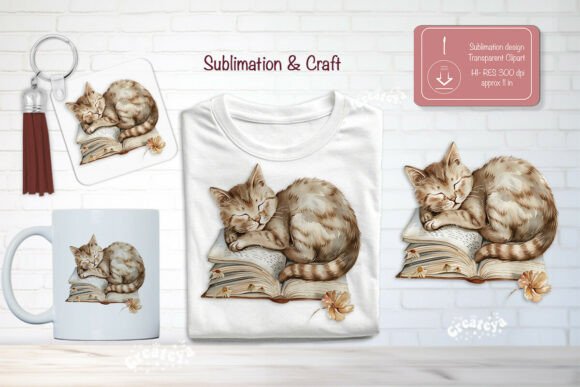
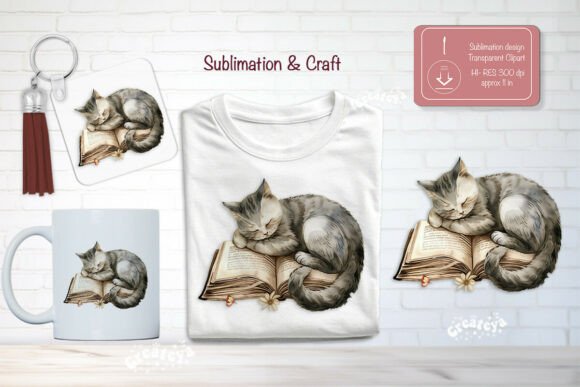
When I opened the Open Book Lover Clipart Sublimation Cat, my first thought wasn’t “cute” — it was “cozy intention.” This isn’t a loud, graphic-heavy design built for maximum shelf impact. It’s watercolor-textured, gently asymmetrical, and leans into quiet storytelling: a curled cat nestled inside an open book, with soft edges and implied pages. As an embroidery designer who’s stitched hundreds of literary-themed pieces, I immediately saw its potential for handmade products that feel personal, not mass-produced — think embroidered tea towels for indie bookshops, baby onesies for librarian parents, or linen pillow covers sold at craft fairs.
Where It Shines in Real Embroidery Projects
I tested Open Book Lover Clipart Sublimation Cat as the focal point on a natural linen tote bag — one of our bestsellers for local author events. The watercolor softness translated beautifully into satin-stitched curves for the cat’s ear and gentle fill-stitch gradients for the book’s spine. Because the original PNG has clean transparency and 300 dpi resolution at 4000 px, scaling down to a 4.5" wide hoop size preserved subtle tonal shifts without pixelation. Customers responded strongly to how “hand-painted” it felt — not like a clipart repeat, but like a small illustration stitched just for them.
It also worked well on midweight cotton sweatshirts (using tear-away + cutaway stabilizer), especially when paired with muted thread colors — heather gray for the book cover, warm taupe for the cat’s fur. For Etsy sellers listing personalized gifts, this design adds instant narrative value: a baby embroidery piece feels tender and literate; a holiday embroidery gift for a teacher lands with warmth, not cliché. As a digital embroidery file, it bridges sublimation and stitch — meaning you can use the same asset for printable mockups *and* real-world stitching, saving time across your craft business.
Where Caution Is Needed — Not Flaws, Just Fit
This isn’t a one-size-fits-all machine embroidery design. Its charm lives in subtlety, so it doesn’t translate cleanly to very small hoop sizes (under 3"). Tiny details — like the faint watercolor bleed along the book’s inner margin or the delicate curve of the cat’s tail — risk disappearing on dense fill stitches or low-resolution digitizing. I wouldn’t recommend it for high-detail applique designs where crisp edges matter most, nor for stretchy fabrics like jersey tees without significant underlay and stabilizer testing.
Dark fabric backgrounds require careful thread color planning: the original watercolor palette assumes light-to-mid tone bases. On charcoal or navy, the softer grays and creams fade unless you adjust contrast manually in your embroidery software. And while it reads beautifully on flat surfaces (tote bags, pillow covers, tea towels), avoid placing it over curved seams or cap fronts — the organic shape doesn’t adapt well to distortion without re-digitizing.
Practical Notes Every Embroidery Designer Should Check
- Always test on scrap fabric first — especially with textured weaves like burlap or slub linen, where watercolor softness can blur further.
- Review stitch density before finalizing. High-density fills may overwhelm the delicate balance between cat and book.
- Confirm hoop size compatibility. At full scale, it’s generous — ideal for 5x7" or larger hoops, less forgiving in 4x4".
- Inspect small details in black-and-white mockups. Does the cat’s eye still read? Does the book’s open page suggest depth, or just a blob?
- Compare light vs. dark fabric backgrounds in your design software. Adjust thread brightness or add outline stitches if needed.
- Use proper stabilizer: medium-weight cutaway for knits, lightweight tear-away for stable wovens.
- Verify licensing before selling finished products or bundling as part of a commercial embroidery project — this is a Graphics asset, not pre-digitized machine embroidery design, so digitizing rights matter.
How It Elevates Your Handmade Product — Beyond Aesthetics
What makes Open Book Lover Clipart Sublimation Cat more than decoration is how it supports trust and intention. Buyers recognize literary motifs as thoughtful — they signal care, attention to detail, and alignment with values (quiet joy, learning, comfort). That lifts perceived value: a $28 embroidered apron feels like a meaningful gift, not just kitchen gear. For small shop owners and Etsy sellers, it strengthens brand consistency across product lines — imagine matching tea towels, baby blankets, and greeting cards all anchored by this same gentle visual voice.
It also improves buyer engagement. In customer surveys, literary-themed embroidery consistently ranks higher for “giftability” and “personal connection.” People don’t just buy a cat-on-a-book — they buy the feeling of curling up with tea and a novel. That emotional resonance translates directly to repeat customers, social shares, and word-of-mouth referrals.
Final Thought: A Thoughtful Asset, Not a Quick Fix
Open Book Lover Clipart Sublimation Cat won’t replace bold, scalable logos or high-impact monograms in your Crafts toolkit — and it shouldn’t. It’s a quiet specialist: perfect for personalized gifts, boutique branding, nursery decor, and handmade products where story matters as much as stitch. Use it intentionally, test it thoroughly, and let its soft watercolor soul guide your choices — not the other way around. For designers, craft business owners, and creative entrepreneurs who value authenticity over algorithm-friendly flash, this is the kind of design that builds real loyalty, one carefully stitched page at a time.